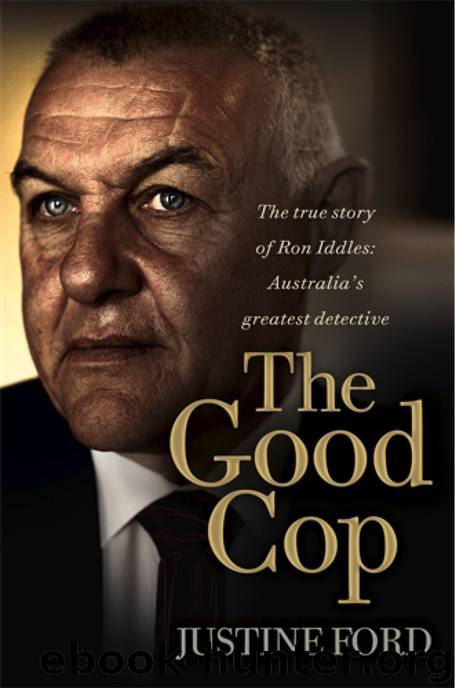
The Good Cop by Justine Ford
Author:Justine Ford [Ford, Justine]
Language: eng
Format: epub
Publisher: Pan Macmillan
Published: 2016-07-05T04:00:00+00:00
13
THE SEVENTEEN-YEAR ITCH
‘I know it sounds strange but I just needed to do something different. It’s quite normal for operational police to feel like that, even if they’ve been passionate about policing.’
– Ron Iddles
The way Ron sees it, drug work suits some detectives but he didn’t want to make a career of it. ‘In the end, you were rarely dealing with people. You were dealing with a product rather than a victim or a victim’s family, and that didn’t suit me.’
In late 1988 Ron was promoted to the rank of detective senior sergeant and filled a short-term vacancy at the Licensing, Gaming and Vice Unit where he carried out administrative duties. ‘I wasn’t there for longer than six weeks when I went back to Homicide,’ Ron says.
Returning as a senior sergeant of thirty-four meant that Ron was now running investigations and leading his own crew. One of the men in his charge was his former lecturer and mentor from Detective Training School, John Hill, who was a detective sergeant. Ron says, ‘It was a bit daunting. John Hill was someone I’d always looked up to and now I’d arrived and was his senior sergeant.’
Ron recalls the first call-out they attended together at a house in Murrumbeena, in Melbourne’s south-east. Upon entering the house, they saw a dead woman sitting in a lounge chair. ‘I remember John asking me what I thought, and at that time he was probably far more experienced at homicide investigation than I was,’ Ron admits. ‘In the end we both came to the consensus it was an overdose, not a murder. There was no sign of forced entry and the blood from her mouth was not bright red, which indicated it could have come from her stomach, suggesting an overdose.’ Forensic tests supported the detectives’ theory.
‘Usually it’s the senior sergeant’s decision how to actually handle a case, but I think John respected me as a hard worker and someone who had made their own reputation, so we had a mutual respect for each other,’ Ron adds.
Yet even though Ron was finally leading a team at Homicide, something he had always longed to do, something else was playing on his mind. Something he didn’t see coming.
*
‘I’d been back at Homicide for only three months when I became restless,’ Ron says. ‘Often police officers with around seven to eight years’ experience think about career changes and leave the police force. I don’t think there are many officers who have not thought about it during their career at some time, but it is a big decision to walk away from such a secure job.’
Even though he’d landed his ‘dream job’, he had been an operational police officer since the early 1970s. What would it be like to do something else? he wondered. It was a niggling thought that just wouldn’t go away. ‘In hindsight, I wouldn’t say I was burnt out but I’d never taken any time off from operational work,’ he explains. ‘Others, when they’re promoted, take on a project or something at the Police Academy, but I’d always worked in busy areas.
Download
This site does not store any files on its server. We only index and link to content provided by other sites. Please contact the content providers to delete copyright contents if any and email us, we'll remove relevant links or contents immediately.
Still Foolin’ ’Em by Billy Crystal(36333)
We're Going to Need More Wine by Gabrielle Union(19020)
Plagued by Fire by Paul Hendrickson(17391)
Pimp by Iceberg Slim(14464)
Molly's Game by Molly Bloom(14119)
Becoming by Michelle Obama(10004)
When Breath Becomes Air by Paul Kalanithi(8408)
Educated by Tara Westover(8033)
The Girl Without a Voice by Casey Watson(7870)
The Incest Diary by Anonymous(7661)
Note to Self by Connor Franta(7656)
How to Be a Bawse: A Guide to Conquering Life by Lilly Singh(7458)
The Space Between by Michelle L. Teichman(6911)
What Does This Button Do? by Bruce Dickinson(6185)
Imperfect by Sanjay Manjrekar(5854)
Permanent Record by Edward Snowden(5811)
A Year in the Merde by Stephen Clarke(5396)
Shoe Dog by Phil Knight(5240)
Promise Me, Dad by Joe Biden(5130)
